02 · Applications

Selected AI and Legal Technology Portfolio

A community plugin release for lawyers, followed by systems I independently designed and built, on personal time, using public data (2024–Present).

LegalQuants Plugins

Released
17 Sept. 2026 · free, open source

My role
Product manager · litigation skill author

Built by
11 practising lawyers in the LegalQuants community

Plugins
legalquants.com/lqplugins ↗

Community release · September 2026

LegalQuants Plugins for ChatGPT

I served as product manager for three community-built plugins for lawyers, released as part of the OpenAI for Law ecosystem: LegalQuants Litigation, LegalQuants Transactional, and The LegalQuants Companion. I also authored several of the litigation skills, including cite checking, deposition preparation, document discovery, and drafting.
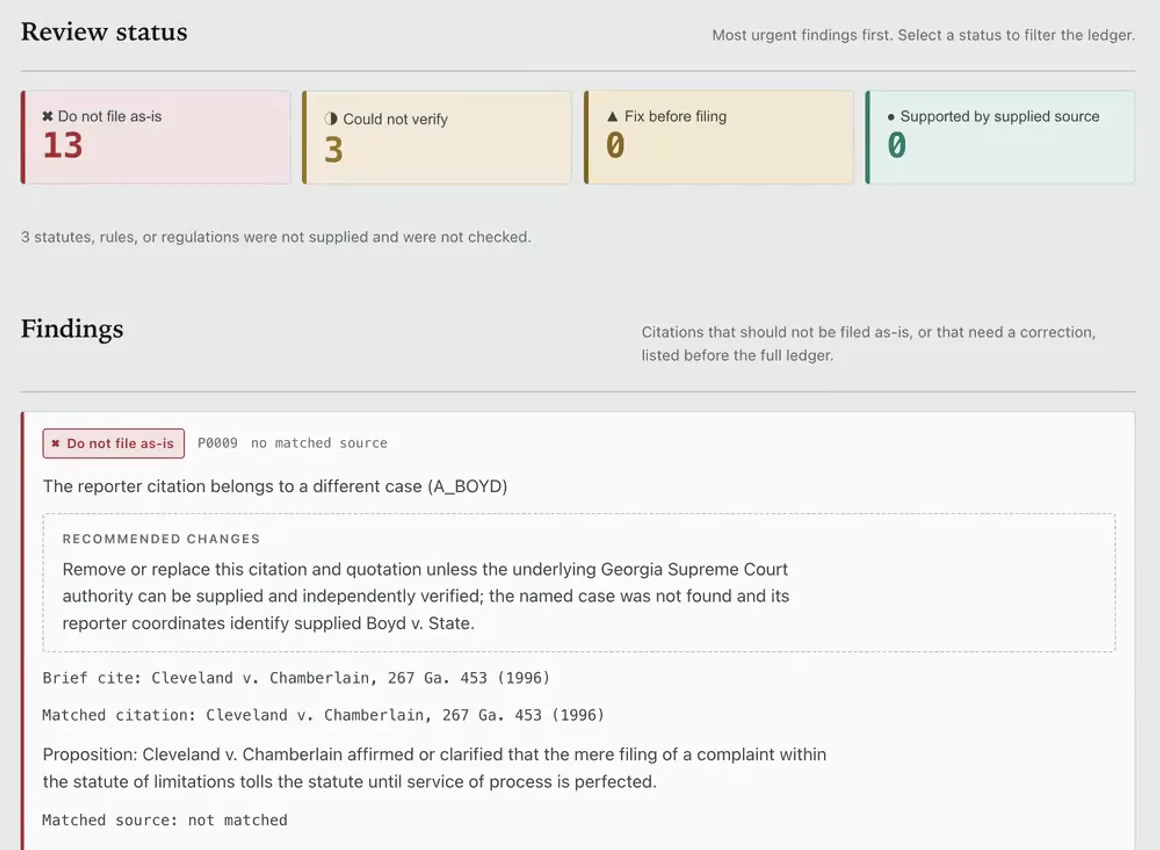
Cite-check report: review-status tallies (13 do not file as-is, 3 could not verify) above a finding that a brief's citation matches a different case.
Fig. 1 · Cite-check report, from the LegalQuants plugin demo
Litigation skills I authored
  • $cite-check
  • $depositions
  • $document-discovery
  • $writing
  • $correspondence
  • $client-update
  • $new-matter
  • $organize-case-docs

Securities Fraud Analyzer

Maturity
Private pipeline, runs daily

Inputs
Public market & filing data, 5,000+ U.S. issuers

Models
Claude · GPT · Gemini, orchestrated

Securities Fraud Analyzer

I built a daily production pipeline that ingests data on 5,000+ U.S. public issuers, flags potential corrective disclosures from abnormal price movements, and prepares PSLRA event-study damages estimates (abnormal returns, stock turnover, 90-day lookback) and insider-trading analyses, generating lawyer-reviewable assessments of pleading-stage strengths and weaknesses through a triage dashboard.

The system uses frontier AI models like GPT and Claude to analyze cases, but adds lawyer expertise and judgment to analyze the viability of claims at a deep level. Among other things, the pipeline can run automated loss causation and event study analysis to estimate the potential damages associated with a claim using the accepted methodology for such calculations, and analyze potential evidence of scienter.

  1. 01 · Ingest

    Public market and filing data, 5,000+ U.S. issuers, daily

  2. 02 · Detect

    Abnormal price drops flag potential corrective disclosures

  3. 03 · Evaluate

    Event-study damages, loss causation, and scienter analysis

  4. 04 · Review

    Lawyers assess claim viability in a triage dashboard

Fig. 2 · Daily analysis pipeline

Habeas Watch

Maturity
Working prototype · pro bono

Inputs
CourtListener / RECAP dockets and filings

Models
Claude + GPT, dual-model extraction

Litigation Data and Docket Intelligence

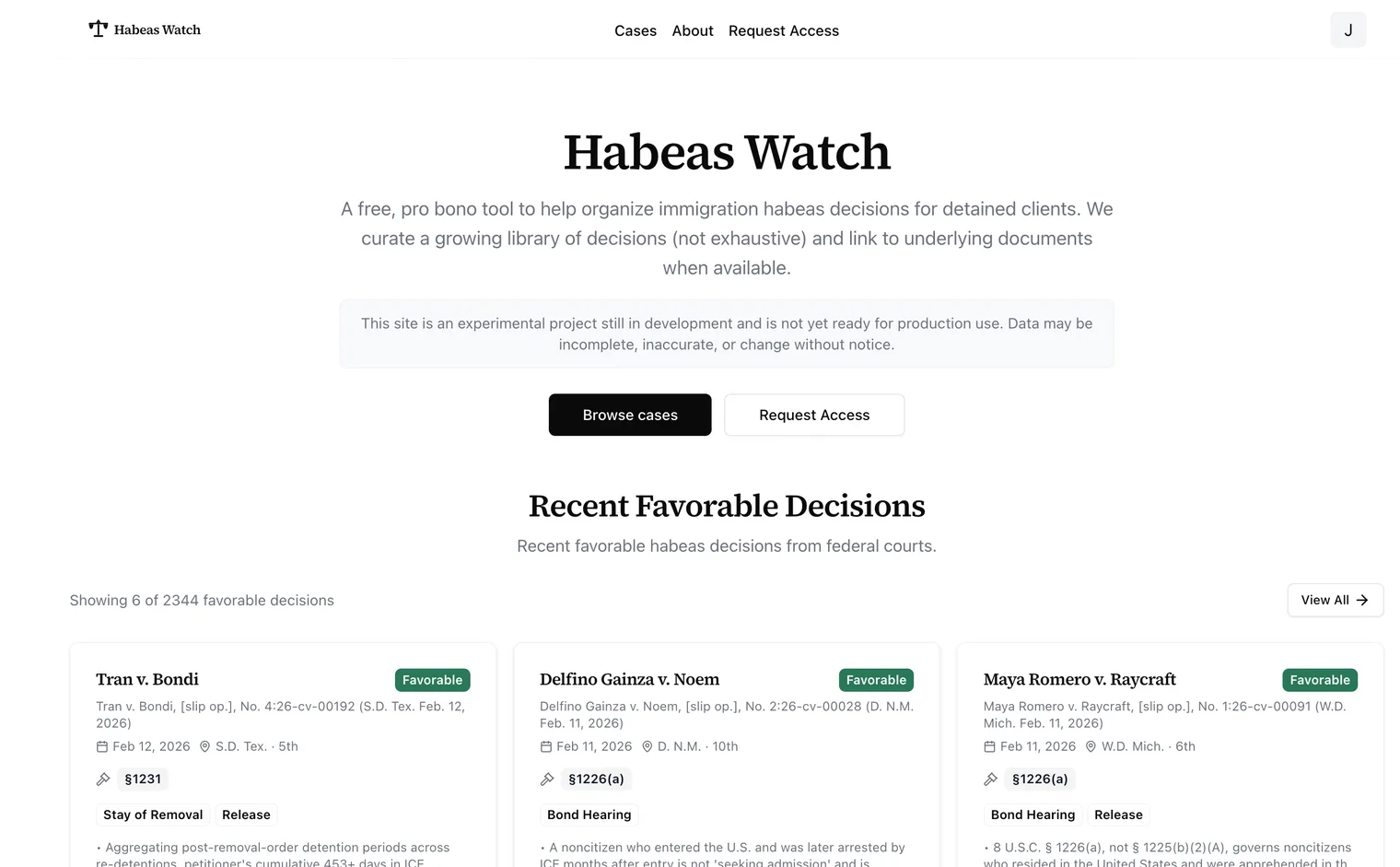
I built Habeas Watch, a pro bono immigration-habeas platform that ingests CourtListener/RECAP docket data, retrieves court documents, classifies cases with dual-model (Claude + GPT) extraction, and surfaces citation-forward summaries for lawyers handling urgent detention matters.

Habeas Watch home page listing recent favorable immigration habeas decisions from federal courts.
Fig. 3 · Habeas Watch, recent favorable decisions

Privilege-aware legal AI control plane

Maturity
Architecture & Azure prototypes · not deployed at any firm

Integration targets
iManage · NetDocuments · Relativity · SharePoint

Related writing
Privilege's fragility in the AI era ↗

Secure, Conflicts- and Privilege-Aware Legal AI Control Plane

I built Azure-first prototypes of a governed law-firm AI control plane for deploying frontier AI tools inside a firm’s own Microsoft tenant. The architecture is designed to integrate advanced AI tools from foundation labs (such as Anthropic’s Claude Cowork and OpenAI’s Codex productivity tools) with existing firm systems, including iManage, NetDocuments, Relativity, and SharePoint.

The system enforces conflict walls and matter attribution for budgeting purposes. It is also informed by my published analysis of attorney-client privilege risk in AI workflows. The tool is also intended to empower knowledge management/innovation personnel by connecting to existing data sources within the firm, while enforcing the firm’s security and risk controls and attorney ethical requirements.

Also built

  • Matter Review and Litigation Knowledge Management. I built an AI-native matter-review workspace prototype with matter vaults, chat, tabular document review, source citations, and Azure-hosted deployment architecture.
  • Agentic Engineering. I built the engineering substrate beneath this work: multi-agent orchestration with worktree isolation and permission boundaries, multi-model provider routing (Claude/Codex/Gemini), and a fail-closed Cloudflare/GitHub security control plane for protected deployment approvals and short-lived token brokerage. The design supports unsupervised, long-running agent sessions without permission-prompt interruptions while holding strict security boundaries and a minimal blast radius against supply-chain and other AI-development risks.